What are Ilanot?
An Ilan, a Hebrew word for “tree,” is an arboreal diagram. Kabbalistic Ilanot (plural) were often arboreal, but the term was often used generically for any diagrammatic visualization of kabbalistic knowledge, regardless of the schemata deployed.
Gallery
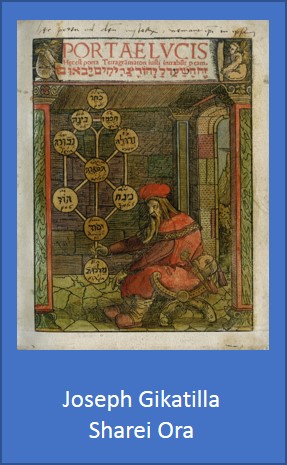
Sha‘arei Orah
The book Sha‘arei Orah by R. Joseph Gikatilla (Spain, 13th century), is one of the foundational works of Kabbalah in the Middle Ages. The book is arranged according to the ten Sefirot, and focuses upon the various names of the Sefirot and their interrelationships.
The drawing appears on the frontispiece of the first printed edition of the book, which appeared in Latin translation in the sixteenth century. The drawing has a number of details that suggest the ways in which it might have been used.
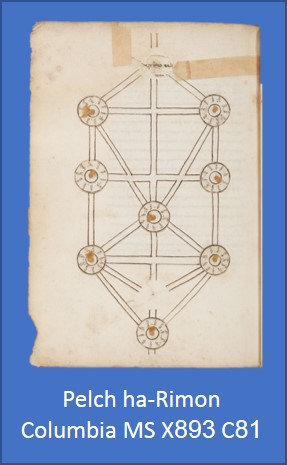
Ilan ‘Asis Rimonim
The book ‘Asis Rimonim is an abridgment of the book Pardes Rimmonim by the kabbalist R. Moses Cordovero. The former work was written in Italy in the sixteenth century, immediately upon receipt of the latter book by the famous Safedian kabbalist.
The Ilan appears in the context of a treatment of the descent of the divine flow into the world. As may be seen, each of the Sefirot is divided into ten. Moreover, the Sefirot are not stationary, but revolve. These revolving discs were known as volvelles, and were often used for the purposes of calculation. In this context, the spinning Sefirot allow the student to visualize the nearly infinite permutations of the divine flow as it makes its way through the Tree.
The manuscript, MS NY Columbia X 893 C 81, was copied in 1579, and may be read about here
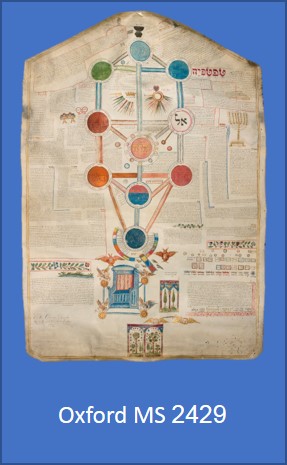
Oxford – Bodleian Library MS Hunt. Add. E. – Oxford MS 2429
This Ilan was copied on parchment in 1578 by the Christian Hebraist James Hepburn, who signed his work here as “Ya’akov Hevron.”
At the center of the parchment we see an Ilan surrounded by texts – the latter being an early fourteenth-century century commentary on the Sefirot by R. Reuven Zarfatti.
The Ilan is distinctive in its use of colors, as well as for its use of a variety of symbolic and decorative elements, including Temple implements, angels, the Throne of Glory, and more.
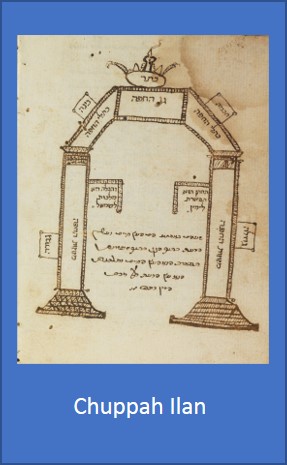
The “Chuppah” Ilan
This diagram is distinctive in its being fashioned in the shape of a wedding canopy (chuppah) rather than as a tree. The Sefirah of Tiferet represents the Groom, and Malkhut the bride; the rest of the Sefirot represent the various segments of the canopy.
This diagram presents the moment of marriage as the expression of the union of male and female so central to kabbalistic thought.
The drawing appears in an Italian manuscript drafted by R. Mordechai Pieto in the sixteenth century, and is in the collection of the Israel Museum (MS 2964).
The Israel Science Foundation-supported Ilanot Project is an ambitious and unprecedented attempt to catalogue and describe all kabbalistic cosmological diagrams and to prepare scientific editions of the greatest exemplars. Its database and planned “Maps of God” site are pioneering digital humanities efforts in Israel. Based at the University of Haifa and working in partnership with the University of Haifa’s Younes and Soraya Nazarian Library, the Ilanot Project also has a longstanding and fruitful cooperation agreement with the National Library of Israel. In recent years, the Ilanot Project has also worked closely with institutions including the British Library, the Columbia University Library, the Bodleian Library at the University of Oxford, and the Library of the Jewish Theological Seminary in New York.
The Ilanot Project – Dr. J. H. Chajes, Director
Dr. Eliezer Baumgarten, Research Fellow & Digital Humanities Project Leader; Dr. Menachem Kallus; Dr. Uri Safrai


